Balcony Design Ideas for Apartment Living (Maximizing Style and Function)
Disclosure : This post may contain affiliate links or paid partnerships. I may earn compensation if you click a link or make a purchase, at no additional cost to you. See my disclosure for more info.
You’re doing it again.
You slide the balcony door open. You step outside. You look around.
Concrete floor. A plastic chair that’s been sitting there since you moved in. A dead plant in the corner — the one you swore you’d take care of this time.
You stand there for maybe ten seconds.
Then you go back inside, close the door, and forget the balcony exists for another three weeks.
Am I wrong?
Look. I get it.
You’ve scrolled through Instagram. You’ve seen those dreamy balconies with the string lights, the cozy blankets, the little herb gardens, the cute breakfast setups.
And every single time, a voice in your head says:
“That’s nice, but my balcony is the size of a bathroom. This stuff doesn’t work for me.”
That voice is lying to you.
A small balcony is not a curse. It’s not a limitation. It’s not a lost cause.
It’s an opportunity hiding in plain sight.
The problem isn’t your balcony. The problem is that nobody ever showed you what to actually do with it — step by step, no fluff, no fairy tales.
That changes today.
By the time you finish reading this, you’ll look at that sad little rectangle of concrete completely differently.
You’ll know exactly what to do. Exactly where to start. And exactly how to turn it into the best room in your apartment — even though it’s technically not a room at all.
Ready?
Let’s go.
Stop. Before You Do Anything, Read This First.
I need to save you from yourself.
Because the number one mistake people make with balcony design is this:
They copy what they see online.
That gorgeous boho terrace on Pinterest? It’s in a ground-floor apartment in Barcelona with 150 square feet of outdoor space and year-round sunshine.
Your 35-square-foot, wind-blasted, north-facing balcony on the seventh floor in Minneapolis?
Not the same thing.
Not even close.
And when you try to copy that setup, you end up frustrated. You end up wasting money. You end up thinking your balcony is the problem.
It’s not.
You just tried to force someone else’s solution onto your space.
Here’s the truth: the best balcony design starts with your balcony. Your dimensions. Your climate. Your sun exposure. Your building rules. Your budget.
Accept the constraints. Work with them. That’s where the magic is.
Now let’s get into the specifics.
1. Measure Your Space (No, Seriously, Do It)
I know.
This sounds boring.
“I don’t need to measure my balcony. I know how big it is. It’s small.”
That’s what everyone says. And then they buy a bistro table that takes up 80% of the floor. And then there’s no room to sit. And then they give up.
Five minutes with a tape measure will save you from this.
Write down the length. The width. The height of the railing. Note where the door swings. Note any drainage spots.
Then grab some painter’s tape and mark out furniture dimensions on the floor.
You’ll see instantly what fits and what doesn’t.
No guessing. No expensive returns. No regret.
This is the least exciting step. It’s also the most important one.
2. Pick Furniture That Does More Than One Job
On a small balcony, every single item needs to earn its place.
If it just sits there looking pretty? It’s dead weight. Get rid of it.
What you want is furniture that multitasks.
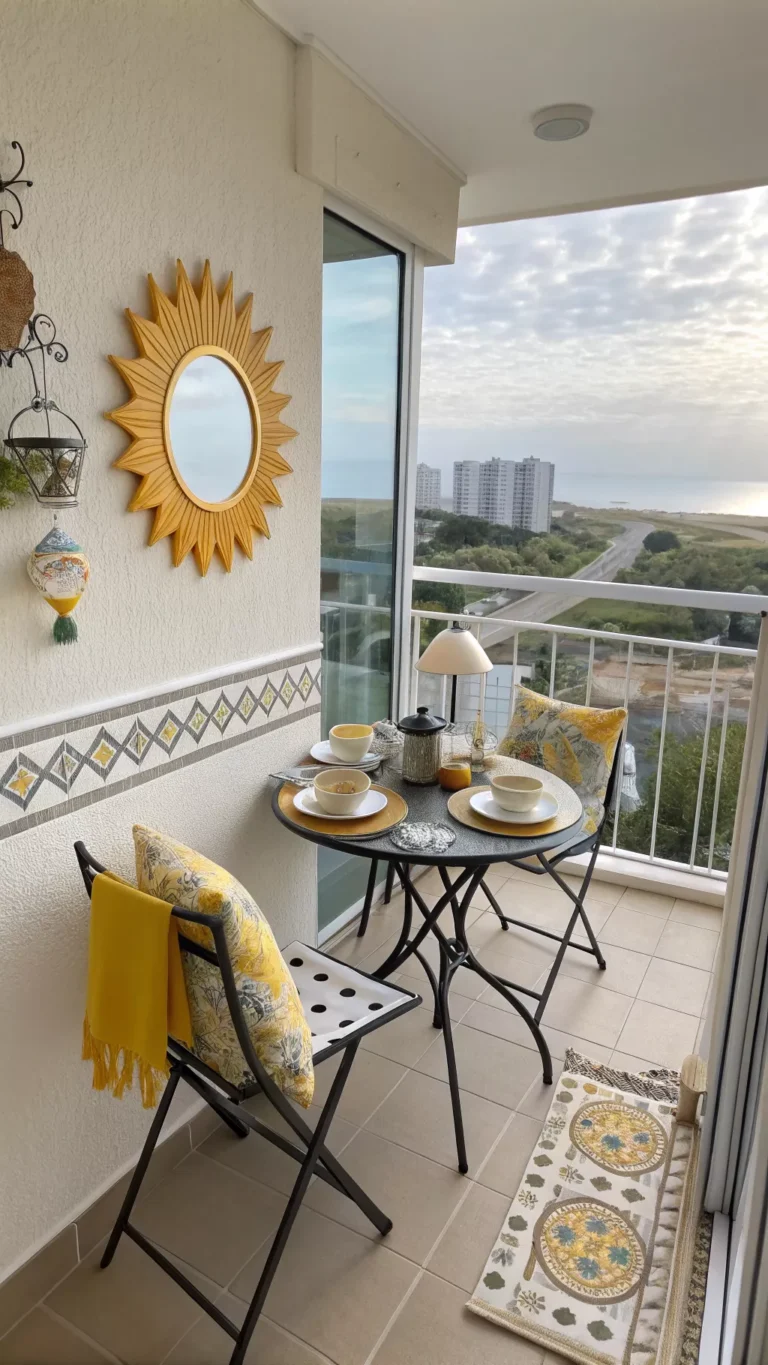
A foldable bistro set that flattens against the wall when you need space. A storage bench that gives you seating AND a place to stash cushions. A wall-mounted drop-leaf table that appears when you need it and disappears when you don’t.
Stackable stools. Nesting side tables. Hanging chairs that free up floor space entirely.
The rule is simple.
If it can’t fold, stack, store something, or serve double duty — it doesn’t belong on your balcony.
Ruthless? Yes.
Effective? Absolutely.
3. Think Up, Not Out
Here’s where most people go wrong.
They think about their balcony in two dimensions. Length and width.
But you’ve got a third dimension that’s completely empty.
Your walls.
They’re sitting right there. Bare. Unused. Begging you to do something with them.
Vertical planters. Wall-mounted shelves. Hanging baskets. Tiered plant stands. Pegboards for tools and accessories.
A single tiered stand can hold six pots in the footprint of one.
Rail-mounted planters add greenery without touching the floor.
Over-the-railing hooks work even if you’re renting and can’t drill.
You want your balcony to feel lush and full?
Go vertical. That’s the cheat code for small spaces.
4. Create Zones (Even If Your Balcony Is Tiny)
This sounds ridiculous, right?
“Zones? On my 30-square-foot balcony? What zones?”
Stay with me.
Even the smallest balcony can have areas of intention.
A chair and a tiny side table in one corner? That’s your morning coffee spot.
Two planters on the railing? That’s your garden area.
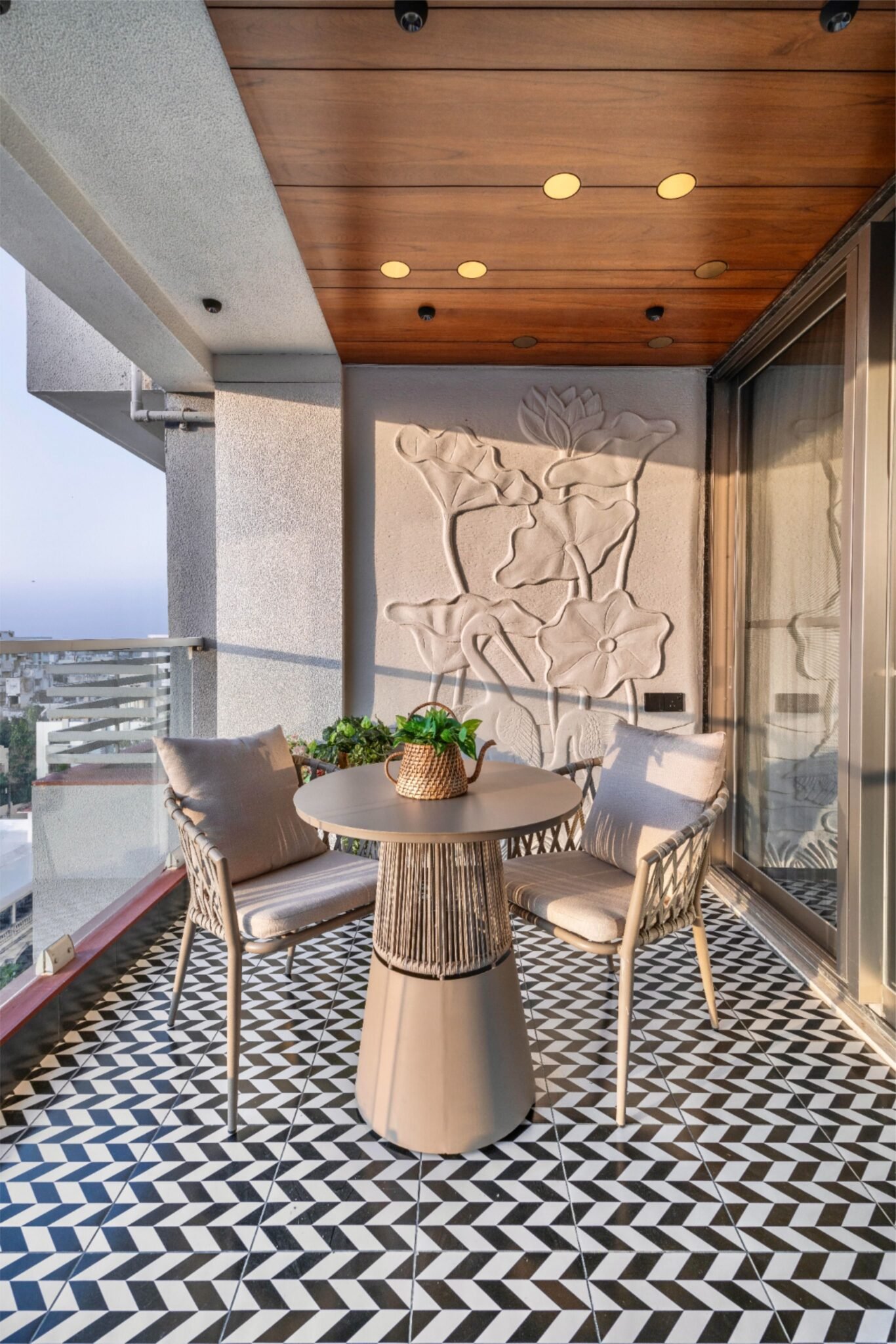
A small outdoor rug under the seating? That visually anchors everything.
You don’t need walls or dividers. You just need placement with purpose.
When a space feels intentional, you use it. When it feels like a random pile of stuff, you avoid it.
That’s human psychology. Use it to your advantage.
5. Get the Lighting Right (This Changes Everything)
You want to know the fastest way to transform a balcony?
It’s not furniture.
It’s not plants.
It’s lighting.
Most apartment balconies have one light source: that harsh overhead fixture near the door.
Which makes your balcony feel about as inviting as a parking garage.
Here’s what you do instead. You layer your lighting.
Overhead: String lights draped along the railing or zigzagged above. Warm white. Not the multicolored Christmas kind.
Mid-level: Battery-operated wall sconces. Solar lanterns on a table or shelf.
Ground level: LED candles in glass holders. Solar path lights in planters.
Three layers. That’s it.
Your balcony goes from cold and clinical to warm and magnetic. The kind of place you don’t want to leave when the sun goes down.
And the whole setup can cost less than a dinner for two.
6. Stop Killing Plants (Here’s How)
Let’s address the guilt.
You’ve bought plants before. They died. You felt terrible. You told yourself you have a “black thumb.”
You don’t have a black thumb.
You just picked the wrong plants for your conditions.
South-facing balcony baking in the sun? You need succulents, lavender, rosemary, geraniums. Tough plants that love heat.
North-facing balcony mostly in shade? You need ferns, begonias, hostas, impatiens. Plants that thrive without direct sun.
Windy high-rise? Go low and sturdy. Thyme, sedum, ornamental grasses. They bend, they don’t break.
Forget to water? Self-watering planters. They keep soil moist for days.
Travel a lot? Snake plants and pothos. Nearly impossible to kill.
Start with three plants. Just three. Get those right.
Then add more.
Building a balcony garden is a marathon, not a sprint. Stop trying to create a jungle in one weekend.
7. Add an Outdoor Rug (Trust Me on This)
I know what you’re thinking.
“A rug? Outside? On a balcony?”
Yes.
This is the single cheapest trick that makes a balcony feel like an actual living space instead of an outdoor hallway.
An outdoor rug adds color. Warmth. Texture underfoot. It visually defines the space. It makes it feel finished.
Get one made for outdoor use — polypropylene or recycled plastic. It resists water, mold, fading, and cleans with a hose.
Choose a size that sits under your furniture but leaves a border of floor showing around the edges.
That border creates an illusion of space.
Simple. Cheap. Effective.
8. Solve the Privacy Problem
Let’s get real about apartment living.
Your neighbor is right there. Four feet away. Probably eating dinner while you’re trying to have a quiet moment.
People across the street can see you.
You feel exposed. So you don’t use the balcony.
Fix this and everything changes.
Tall planters with bamboo or ornamental grasses create a natural screen. Outdoor curtains in weather-resistant fabric give you privacy you can pull shut or tie back. Lattice panels with climbing jasmine or ivy get denser over time.
Reed or bamboo screens zip-tied to your railing are cheap and effective.
You’re not building a bunker. You’re creating just enough separation to feel comfortable.
That’s the difference between a balcony you use every day and one you avoid.
9. Weatherproof Your Setup
Here’s what nobody tells you about balcony design.
It rains.
Wind blows things over. Sun fades fabric. Moisture grows mold on cushions you left out overnight.
If you don’t plan for weather, your beautiful setup will look terrible in two months.
Solution: weatherproof everything.
Get furniture made from aluminum, resin wicker, or treated wood — materials that handle the elements.
Store cushions in a small deck box when you’re not using them. Bonus: the box doubles as extra seating with a cushion on top.
Use fade-resistant fabric for any textiles. Sunbrella is the gold standard, but there are cheaper alternatives.
And if a storm is coming? Bring the fragile stuff inside. Takes two minutes. Saves you from replacing everything next season.
10. Swap Accessories, Not Everything, With the Seasons
This is how burnout happens.
You design a beautiful summer balcony. Fall arrives. It looks wrong. You feel like you need to start over.
So you don’t. You just stop going out there until next spring.
Stop doing this.
Instead, build a base that works year-round. Your furniture. Your rug. Your main lighting.
Then change the small stuff.
Summer: bright cushion covers, flowering plants, cold drink glasses.
Fall: warm-toned throws, ornamental kale, candles.
Winter: evergreen cuttings, fairy lights, a thick blanket.
You’re swapping accessories, not redesigning the whole space.
Thirty minutes. Almost no cost. Fresh feeling every season.
11. Respect Your Building’s Rules
This one isn’t fun to talk about.
But it matters.
Many apartment buildings have strict rules about balconies. What you can hang. What you can mount. What colors are allowed. Whether grills are permitted.
Check your lease before you do anything permanent.
Some buildings ban drilling into exterior walls. Some don’t allow railing attachments. Some prohibit certain types of furniture.
Find out first. Design second.
Getting a violation notice after you’ve spent hours setting up your dream balcony?
That’s a pain you can avoid entirely.
12. Start With One Thing. This Weekend.
You’ve just read a lot of ideas.
And right now, your brain is doing one of two things.
Either it’s excited and already planning.
Or it’s overwhelmed and thinking, “This is too much.”
If you’re in the second camp, listen to me.
You don’t have to do everything at once.
Pick one thing from this list. Just one.
Buy the rug. Hang the string lights. Get three plants that actually match your sun exposure.
Do that one thing this weekend.
Next weekend, do another.
The weekend after that, another.
In a month, you’ll step onto your balcony and barely recognize it.
You’ll sit down. You’ll take a breath. You’ll look around and think, “Why didn’t I do this sooner?”
That moment is waiting for you.
Go get it.