Light It Right: 29 Kitchen Lighting Ideas That Instantly Upgrade Your Space
Disclosure : This post may contain affiliate links or paid partnerships. I may earn compensation if you click a link or make a purchase, at no additional cost to you. See my disclosure for more info.
You walk into your kitchen every single morning.
You flip the switch. The same flat, lifeless glow fills the room. And something feels… off.
You can’t quite put your finger on it. The cabinets look dull. The countertops feel cheap. The whole space looks like it belongs in a rental from 2004.
Here’s the thing.
Your kitchen might not need new countertops. It might not need a full renovation. It might not even need a fresh coat of paint.
It might just need better light.
Lighting is the most underrated upgrade in home decor. It can make a $10,000 kitchen look like a $50,000 kitchen. Or the opposite — make a gorgeous space look flat, cold, and forgettable.
The problem?
Most people treat kitchen lighting as an afterthought. One flush mount on the ceiling. Done. Move on.
And then they wonder why their kitchen never looks like the ones on Pinterest.
By the end of this article, you’ll know exactly how to layer your kitchen lighting like a designer, avoid the mistakes that make kitchens look harsh or gloomy, and pick the right fixtures for every zone — without blowing your budget.
Let’s get into it.
Why Your Kitchen Feels “Off” (And Why It’s Probably the Lighting)
Here’s something most people don’t realize.
Lighting affects how you perceive every single surface in your kitchen. The color of your cabinets. The texture of your backsplash. Even whether your food looks appetizing on the counter.
Bad lighting doesn’t just look bad. It feels bad. It makes you tired. It gives you headaches. It turns your kitchen into a room you want to leave as fast as possible.
Good lighting does the opposite.
It makes the space feel warm, inviting, and alive. It pulls your eyes toward the things you want to show off. And it makes cooking, eating, and hanging out in the kitchen actually enjoyable.
The secret? Layering.
You need three types of light working together: ambient, task, and accent. Miss one of those layers, and the whole thing falls apart.
Let’s break down the 29 ideas that make it work.
Ambient Lighting: The Foundation of Everything
Ambient light is your base layer. It’s the general glow that fills the room. Without it, every other fixture is fighting the dark.
1. Recessed ceiling lights on a dimmer
Recessed lights are workhorses. But without a dimmer switch and suddenly you control the mood. Bright for cooking. Soft for dinner. That one swap changes everything.
2. A flush mount with frosted glass
If you don’t have space for recessed cans, a flush mount with a frosted diffuser spreads light evenly without creating harsh shadows.
Skip the clear glass. It shows every speck of dust and throws glare everywhere.
3. Semi-flush mount with a fabric shade
Want something a little warmer? A semi-flush mount with a linen or fabric shade softens the light beautifully.
It’s one of the easiest ways to make a kitchen feel less “industrial” and more lived-in.
4. LED panel lights for low ceilings
Got a kitchen with low ceilings? Bulky fixtures will make it feel like a cave.
Slim LED panels sit nearly flat against the ceiling and throw an even, bright glow. Clean and modern.
5. Cove lighting along the ceiling perimeter
This one’s a designer favorite. LED strip lights hidden in a small ledge along the ceiling create a soft, indirect glow that makes the whole room feel taller.
Subtle. Elegant. And surprisingly affordable with LED strips.
Task Lighting: Where Function Meets Beauty
Task lighting is about seeing what you’re doing. Chopping onions in the dark is annoying at best and dangerous at worst.
But here’s the part most people miss: task lighting can also look incredible.
6. Under-cabinet LED strips
This is the single most impactful lighting upgrade you can make in a kitchen.
Under-cabinet strips illuminate your countertops, eliminate shadows, and make your backsplash pop. Peel-and-stick LED strips make this a weekend project.
7. Under-cabinet puck lights
If you want pools of focused light rather than a continuous strip, puck lights are the move.
They create a slightly more dramatic look. Great for highlighting specific work zones.
8. Pendant lights over the island
This is where most people finally pay attention to kitchen lighting. And for good reason.
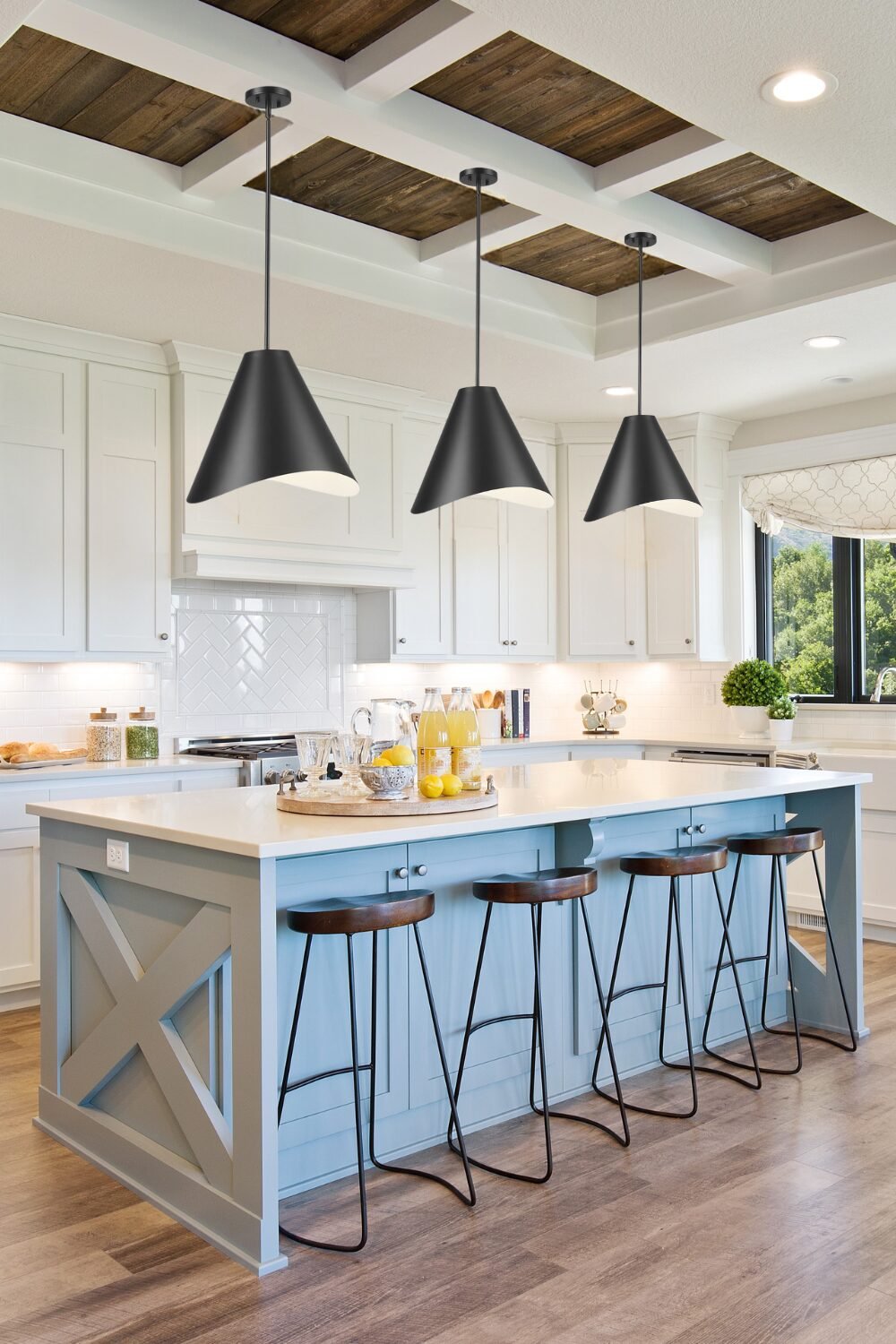
A pair of pendants (or a trio, depending on island length) creates a focal point and lights up your prep area. Hang them about 30 to 36 inches above the countertop.
9. Linear suspension light over the island
Don’t want multiple pendants? A single linear suspension fixture stretches across the island and gives a sleek, modern look.
It distributes light more evenly than individual pendants, too.
10. Adjustable track lighting
Track lighting gets a bad reputation because people associate it with the 1990s.
But modern track systems are slim, minimal, and incredibly flexible. You can aim each head exactly where you need it. Perfect for kitchens with weird layouts.
11. Swing-arm wall sconces near the stove
This one’s unusual. And that’s exactly why it works.
A swing-arm sconce mounted near your range gives you focused light right where you cook. Plus, it adds a layer of character that nobody expects in a kitchen.
12. Lighted range hoods
Your range hood already has a built-in light. But most stock bulbs are terrible.
Swap them for bright, warm-toned LEDs. Suddenly your stovetop is properly lit, and you can actually see what you’re searing.
Accent Lighting: The Secret Weapon Designers Use
This is the layer that separates a “nice” kitchen from a “wow” kitchen.
Accent lighting doesn’t illuminate tasks. It creates atmosphere. It highlights what’s beautiful and hides what’s not.
13. In-cabinet lighting for glass-front cabinets
Got glass-front cabinets? They’re useless without light inside them.
Small LED puck lights or strips inside the cabinet turn your glassware and dishware into a display. Instant elegance.
14. Above-cabinet lighting
If your upper cabinets don’t reach the ceiling, that gap is dead space.
Place LED strips on top of the cabinets, facing the ceiling. The upward wash of light makes the ceiling feel higher and adds a warm glow to the room.
15. Toe-kick lighting
LED strips hidden under your base cabinets, at floor level. It’s like a runway for your kitchen.
This is a pure luxury touch. Looks incredible at night. And doubles as a gentle nightlight when you stumble to the fridge at midnight.
16. Backlit floating shelves
Open shelving is everywhere right now. But without proper lighting, your carefully styled shelves disappear after sunset.
LED strips behind or underneath floating shelves create a soft halo effect. Your books, plants, and ceramics get the spotlight they deserve.
17. Illuminated kickboard panels
Similar concept to toe-kick lighting, but with translucent panels that glow.
It’s a bold, modern move. Not for every kitchen, but if you’re going for a contemporary look, it’s a showstopper.
18. LED strips inside drawers
Open a drawer and it lights up. That’s it.
Motion-activated LED strips inside deep drawers make it easy to find utensils and gadgets. Practical and surprisingly impressive when guests see it.
Statement Fixtures: The Pieces That Define Your Kitchen
Sometimes one bold fixture does more than ten subtle ones.
19. Oversized single pendant
One large pendant — woven rattan, blown glass, sculptural metal — hung over the island or dining nook becomes the centerpiece of your kitchen.
It anchors the space and gives the eye somewhere to land.
20. Chandelier over the eat-in area
Yes, a chandelier in the kitchen. It works.
A small chandelier (crystal, beaded, or simple iron) over a breakfast nook or eat-in table instantly elevates the entire room.
It tells people: this isn’t just a cooking space. It’s a gathering place.
21. Lantern-style pendant
Lantern pendants bring old-world charm. They work beautifully in farmhouse, transitional, and even eclectic kitchens.
The cage design lets light escape in every direction while adding architectural interest overhead.
22. Cluster pendant arrangement
Instead of two or three evenly spaced pendants, hang a cluster of small pendants at varying heights.
It looks artistic, intentional, and way more interesting than the standard layout. Interior designers love this trick.
Smart and Specialty Lighting: The Future Is Already Here
You don’t need a smart home to use smart lighting. Just a little curiosity.
23. Smart bulbs with tunable color temperature
Warm light in the evening. Cool, bright light when you’re cooking.
Smart bulbs let you shift the color temperature throughout the day. Your kitchen adapts to what you need, when you need it.
24. Motion-sensor cabinet lights
Stick them inside pantry cabinets or closets. Open the door, the light turns on.
No wiring. Battery powered. Takes five minutes to install. And you’ll wonder how you ever lived without them.
25. Integrated LED cabinet handles
This one is niche, but worth mentioning.
Some modern cabinet hardware comes with built-in LED lighting. The handle itself glows softly. Futuristic and functional.
26. Skylight or solar tube for natural light
No amount of electric light fully replaces daylight.
If your kitchen lacks windows, a solar tube — a small, reflective tube from roof to ceiling — can flood the room with natural light without a major renovation.
Color Temperature and Placement: The Details That Make or Break It
You can buy the best fixtures in the world and still ruin the look with the wrong bulb.
27. Stick to 2700K–3000K for warmth
Cool white light (4000K+) makes kitchens feel like hospitals.
For a warm, inviting kitchen, keep your bulbs between 2700K and 3000K. This range flatters wood tones, skin tones, and food.
If you do a lot of detailed cooking, consider 3500K for task areas only.
28. Mix light levels, not color temperatures
Here’s a mistake that’s everywhere: mixing warm and cool bulbs in the same room.
It creates visual confusion. Your brain can’t settle. Everything looks mismatched.
Keep the color temperature consistent across all fixtures. Vary the brightness with dimmers instead.
29. Place lights where shadows form
Stand at your counter and look at your hands. If there’s a shadow falling right where you chop, your lighting placement is wrong.
The fix is simple. Task lights should be in front of you, not behind. Under-cabinet strips solve this in most kitchens instantly.
The Mistake That Costs You the Most
Here it is. The one mistake that wastes more money than any other.
Buying fixtures before planning layers.
People fall in love with a gorgeous pendant on Instagram. They buy it. Hang it. And realize it doesn’t solve any of their actual lighting problems.
The kitchen still has dark corners. The counters still have shadows. The room still feels flat.
Start with the three layers: ambient, task, accent. Figure out what’s missing. Then choose fixtures that fill those gaps.
The prettiest fixture in the world is useless if it’s in the wrong place.
Your Kitchen Deserves Better Than One Ceiling Light
Look, you spend more time in your kitchen than almost any other room.
You cook there. You eat there. You gather there. You have conversations there at 11 p.m. with a glass of wine and leftovers.
That room deserves lighting that does it justice.
You don’t need to do all 29 ideas. Start with two or three that address your biggest frustrations. Maybe that’s under-cabinet strips to kill the countertop shadows. Maybe that’s a dimmer on your overhead light. Maybe it’s finally hanging those pendants over the island.
Small changes. Massive impact.
The best part? Most of these upgrades cost less than a single piece of furniture. But they’ll change the way your kitchen looks and feels more than almost anything else you could buy.
Go light it right.