Bunk Bed Bliss: 17 Ideas That Add Personality to Small Spaces
Disclosure : This post may contain affiliate links or paid partnerships. I may earn compensation if you click a link or make a purchase, at no additional cost to you. See my disclosure for more info.
You stare at the room. Again.
You measure it. Again. You open Pinterest, scroll for forty-five minutes, and close the app feeling worse than before.
Because every gorgeous bedroom you see online has one thing in common: space you don’t have.
Your room? It’s tight. It’s cramped. And you’ve got two kids — or a guest situation — or a studio apartment that needs to work triple duty.
You’re not asking for a magazine cover. You just want a room that doesn’t feel like a storage unit with mattresses.
“There has to be a way to make bunk beds look good, right? Not like a summer camp cabin. Not like a dorm room. Something with actual personality.”
I hear you.
And I’m going to tell you the truth: bunk beds are one of the most underrated design tools for small spaces. Not a compromise. Not a sacrifice. A genuine advantage — if you know how to use them right.
The problem? Most people treat bunk beds as purely functional. Slap two mattresses on a metal frame, call it a day, and wonder why the room feels lifeless.
That’s about to change.
In this article, you’ll discover 17 specific ideas that turn bunk beds from boring to brilliant. Ideas that solve real problems — storage, style, privacy, lighting — while making your small space feel intentional, not accidental.
Let’s go.
Why Bunk Beds Deserve Better Than What You’re Giving Them
Here’s the thing nobody tells you.
A bunk bed is the largest piece of furniture in most small rooms. It dominates the visual space.
So when it looks generic, the whole room looks generic. There’s no curtain, no plant, no cute throw pillow that can fix a boring bunk bed.
But flip that logic around. Make the bunk bed the star, and suddenly everything else falls into place.
That’s the mindset shift. Stop decorating around the bunk bed. Start decorating with it.
Now, let’s get into the ideas.
The 17 Ideas That Actually Work
1. Built-In Reading Nooks With Individual Lighting
Each bunk should have its own wall-mounted sconce or clip-on reading light.
It sounds small. It’s not. Individual lighting gives each sleeper autonomy. No more fighting about when the lights go off.
Plus, it instantly makes each bunk feel like a private retreat instead of just a shelf to sleep on.
Look for warm-toned LED sconces that attach without heavy wiring. Peel-and-stick options exist now that look surprisingly high-end.
2. Curtains on Each Bunk for Privacy
This one is a game-changer for shared rooms.
Simple curtain rods — or even tension rods — mounted along the opening of each bunk. Add fabric panels, and suddenly each child (or guest) has their own cocoon.
It works for adults too. If you’re running an Airbnb or hosting family, curtained bunks feel like sleeper train compartments. There’s something oddly luxurious about it.
Choose fabrics that match your room’s palette. Linen gives a relaxed look. Velvet adds drama.
3. A Bold Accent Wall Behind the Bunks
Paint the wall directly behind the bunk bed a contrasting color. Deep navy. Forest green. Charcoal.
The bunk bed becomes framed. It looks deliberate. Designed. Not like something you shoved into a corner because you had to.
This works even better with light-colored bunk frames. The contrast does all the heavy lifting.
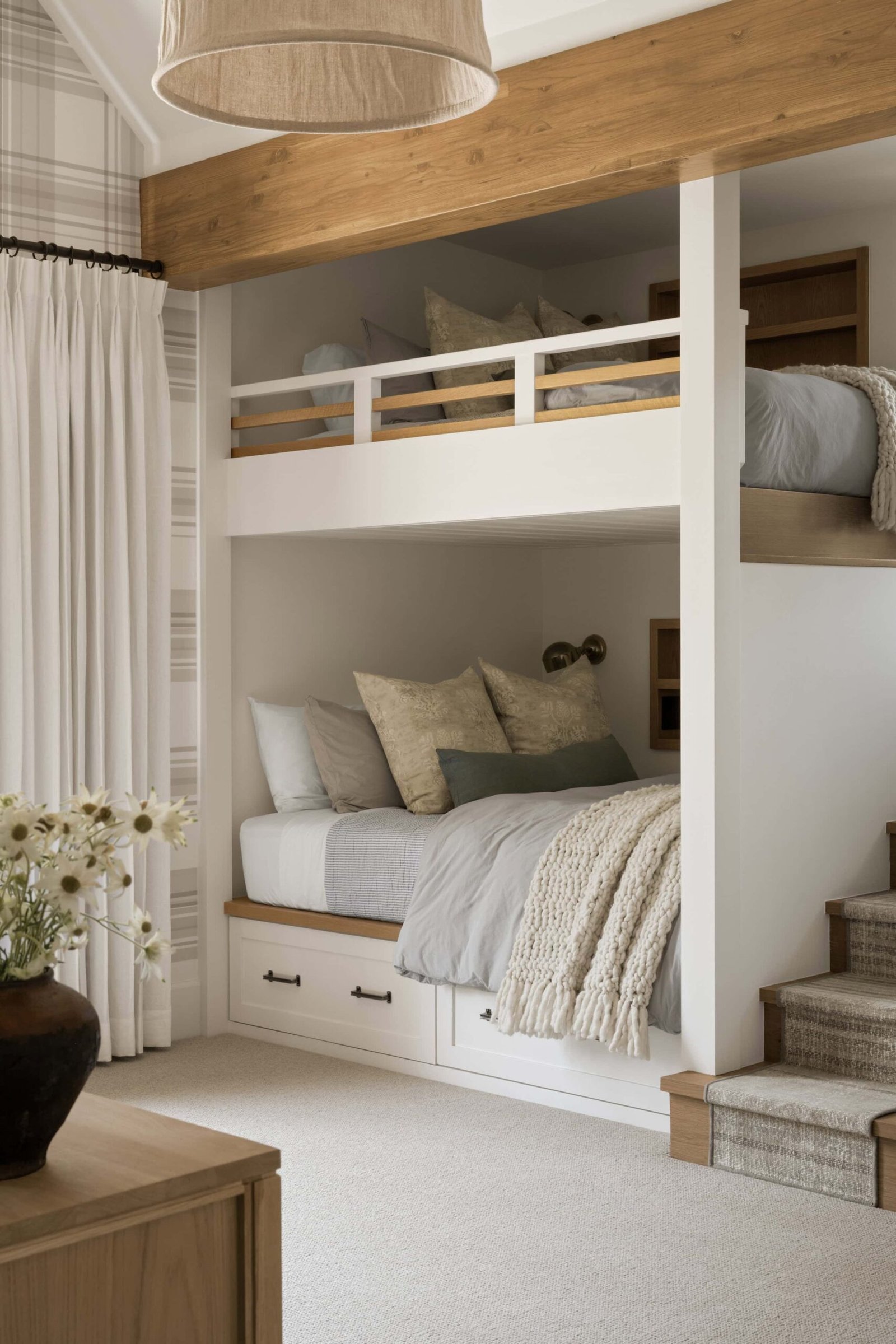
4. Custom Storage Stairs Instead of Ladders
Ladders are functional. Storage stairs are functional AND beautiful.
Each step doubles as a drawer. Socks, books, toys, shoes — they disappear.
In a small room, this is not optional. It’s survival. You need every cubic inch. And storage stairs deliver that without adding any extra footprint.
They also feel safer for younger kids. Win-win.
5. Matching Bedding That Tells a Story
Don’t just buy “whatever fits.” Coordinate the bedding across both bunks.
Not identical — coordinated. Same color family, complementary patterns. One bunk in a solid sage green, the other in a sage-and-white stripe.
It ties the whole structure together visually and makes the bunk bed look like a designed piece rather than two random beds stacked.
6. A Trundle Drawer on the Bottom Bunk
If your lower bunk sits high enough, slide a trundle bed or storage drawer underneath.
Extra sleeping for sleepovers. Extra storage for off-season clothes. Either way, you’re using dead space that would otherwise collect dust bunnies.
Some trundle designs even come on casters, making them easy to pull out and push back in seconds.
7. Personalized Name Signs or Initials Above Each Bunk
This sounds like a tiny detail. But for kids sharing a room, it’s huge.
A small wooden name sign, a framed initial, or even a custom decal above each bunk gives each child ownership of their space.
It reduces the “this is YOUR side, this is MY side” arguments. Because now, the room tells them: you each have your own place.
8. Floating Shelves Next to Each Bunk
A narrow floating shelf within arm’s reach of each bunk.
For a water bottle. A book. A small plant. A photo frame.
It replaces the nightstand that you don’t have room for. And it keeps the floor clear, which is critical in tight spaces.
Mount them at slightly different heights — one for the top bunk, one for the bottom. Instant functionality.
9. An L-Shaped Bunk Configuration
Not all bunk beds need to be stacked directly on top of each other.
L-shaped bunks place the bottom bed perpendicular to the top one. This opens up floor space underneath the elevated bunk for a desk, a reading corner, or storage.
It also makes the room feel less tunnel-like. The asymmetry creates visual interest.
If you have even a slightly awkward room layout, this configuration might be the answer you’ve been ignoring.
10. Wallpaper Inside Each Bunk Alcove
Here’s where things get fun.
Line the interior walls of each bunk with peel-and-stick wallpaper. A soft botanical print. A subtle geometric. Even a starry night pattern for the top bunk.
Each sleeper gets their own micro-world. And because the wallpaper is contained within the bunk frame, you can go bolder than you’d dare on a full wall.
It’s removable, so commitment-phobes — this one’s for you.
11. Under-Bed Lighting for the Top Bunk
Mount a strip of warm LED lights along the underside of the top bunk.
It gives the lower bunk a soft ambient glow. Cozy. Not clinical.
It also serves a practical purpose: enough light to find your way to the bathroom at 2 a.m. without turning on the overhead.
Battery-operated, remote-controlled strips make this a ten-minute project.
12. A Slide Instead of a Ladder
Yes, really.
For children’s rooms, a small slide attachment turns the bunk bed into something kids actually look forward to using.
It takes up a bit more floor space than a ladder, so measure carefully. But the payoff in excitement — and the reduction in morning battles — is absolutely worth it.
Several bunk bed manufacturers now offer slide-compatible models. Some slides are even removable for when the novelty wears off (or when the kids grow up).
13. Desk Integration Below the Top Bunk
A loft-style bunk with a built-in desk underneath is one of the smartest moves for a teen’s small bedroom.
The bed goes up. The workspace goes below. You’ve just freed up an entire wall.
Pair the desk area with good task lighting, a small corkboard, and a shelf, and you’ve created a functional study zone that didn’t exist five minutes ago.
This is especially powerful in studio apartments where every square foot has a job to do.
14. Rope or Macramé Basket Hanging Storage
Attach a hanging basket or macramé organizer to the side rail of the top bunk.
It catches stuffed animals, headphones, books — whatever tends to pile up.
It adds texture and visual warmth to the frame without taking up any floor or shelf space.
Plus, it gives the bunk bed an artisanal, handcrafted feel that softens an otherwise utilitarian structure.
15. Bunk Beds With Mismatched Frame Finishes
Who says both bunks need to match perfectly?
Try a natural wood frame on top and a white-painted frame on the bottom. Or matte black metal on top with warm oak below.
This two-tone approach adds depth and personality. It signals that the room was curated, not assembled from a single catalog page.
Just keep one unifying element — the same hardware finish, or the same bedding tones — so it reads as intentional, not chaotic.
16. A Canopy Drape on the Top Bunk
Hang a lightweight canopy fabric from the ceiling above the top bunk.
It turns the top bunk into something almost magical. A tent. A hideaway. A nest in the sky.
For younger kids, this is the stuff of dreams — literally. For adults in shared living situations, it provides a sense of enclosure and privacy that makes a world of difference.
Sheer white fabric works beautifully. It lets light through while still creating that enclosed feeling.
17. A Cohesive Color Palette Across the Entire Room
This is the one that ties everything together.
Pick three colors maximum. Apply them to the bunk frame, the bedding, the wall, the shelves, and the accessories.
When a small room has too many competing colors, it feels chaotic. When it has a disciplined palette, it feels calm, spacious, and intentional.
This isn’t about being boring. A palette of terracotta, cream, and black is anything but boring. It’s about editing ruthlessly so the room breathes.
The Mistake That Ruins Most Bunk Bed Rooms
Here it is, and it’s painfully common.
Overcrowding.
You’ve got a small room. You’ve added a bunk bed. And then you pile in a dresser, a toy bin, a bookcase, two rugs, and a bean bag chair.
The bunk bed was supposed to save space. But you filled that saved space with more stuff.
Resist. Keep the floor as clear as possible. Let the bunk bed and its built-in solutions — the storage stairs, the floating shelves, the trundle — do the work.
A small room with breathing room feels ten times larger than a small room stuffed to the gills.
Your Small Space Isn’t a Limitation — It’s a Brief
Designers know this. Constraints breed creativity.
The best hotel rooms in the world are small. The most charming Parisian apartments are small. The coziest cabins are small.
What they all share is intentionality. Every piece earns its place. Nothing is there by accident.
Your bunk bed room can be exactly the same.
You don’t need more space. You need a better plan for the space you already have. And now, you’ve got 17 concrete ways to make it happen.
So pick two or three ideas from this list. Start there. See how the room transforms.
Because a room with personality doesn’t require square footage.
It requires decisions.
And you just made a great one by reading this far.
Now go make your bunk beds work as hard as you do.