Beige Kitchen Goals — 29 Design Tricks That Feel Warm, Sleek, and Timeless
Disclosure : This post may contain affiliate links or paid partnerships. I may earn compensation if you click a link or make a purchase, at no additional cost to you. See my disclosure for more info.

You’re standing in your kitchen right now.
Look around.
The countertops are cluttered. The cabinets feel dated. The walls scream “rental apartment,” and the whole room has the personality of a hospital cafeteria.
You’ve been saving pins. Hundreds of them. Maybe thousands. Beautiful kitchens drenched in soft, sandy tones. Creamy cabinetry. Warm wood accents. Stone countertops that look like they belong in a Tuscan villa.
And every single time you close that app, you feel the same thing.
The gap between what you see and what you live in.
It’s maddening, right?
Because you know what you want. You can practically smell the fresh coffee brewing in that dream beige kitchen, feel the cool marble under your fingertips, hear the soft click of those perfectly aligned cabinet doors.
But you don’t know where to start.
You’re terrified of spending money on the wrong shade. Terrified of picking a trend that dies in eighteen months. Terrified your beige kitchen will look boring instead of breathtaking.
Here’s the good news.
Beige is not boring. Beige is a weapon. And when you use it correctly, it creates a kitchen so warm, so sleek, and so timeless that people will literally stop mid-conversation when they walk in.
The bad news? Most people get beige completely wrong.
So let’s fix that. Right now. All 29 tricks. No fluff, no filler, just the real stuff that actually works.
Ready? Let’s go.
H2: The Foundation — Getting Your Beige Base Right
Before you even think about hardware or backsplashes, you need to nail the base. Get this wrong and everything else crumbles.
1. Choose an undertone before you choose a color.
This is where most people mess up catastrophically.
Beige isn’t just beige. It has undertones — pink, yellow, green, gray. A beige with pink undertones will feel completely different from one with gray undertones.
Hold your swatch against a pure white sheet of paper. The undertone will reveal itself. Pick the undertone first, then the shade.
2. Go warmer on north-facing kitchens, cooler on south-facing ones.
Natural light changes everything. A north-facing kitchen gets cool, bluish light. So you need a beige that leans warm — think honey, wheat, or golden sand.
South-facing? You can afford a cooler, grayer beige because the sunlight will warm it up naturally.
Ignore this rule and your beautiful beige will look like mud. Or worse — like baby food.
3. Test your paint at three different times of day.
Morning light, afternoon light, evening light. Same wall, three completely different colors. Slap that sample on the wall and live with it for at least 48 hours before committing.
The shade that looked perfect at noon might look sickly yellow at 7 PM under your kitchen lights.
4. Use matte finishes on walls, satin on cabinets.
Matte gives depth and sophistication on large surfaces. But on cabinets that get touched constantly? Matte is a fingerprint magnet and a cleaning nightmare.
Satin finish on cabinetry gives you that subtle sheen without looking plasticky. It’s the sweet spot between elegance and practicality.
H2: Cabinet Tricks That Make Beige Look Expensive
Cabinets eat up the most visual real estate in any kitchen. Get them right and you’re halfway to the finish line.
5. Use shaker-style cabinets for a timeless silhouette.
Flat-panel cabinets look modern but can feel cold. Ornate raised-panel cabinets can feel dated fast. Shaker style sits right in the middle — clean lines, subtle detail, works with literally every beige palette.
It’s the little black dress of kitchen cabinetry.
6. Go handleless on upper cabinets, add hardware on lower ones.
This creates a visual trick that makes your kitchen feel taller. The eye moves upward without interruption on the upper cabinets, while the hardware on the lower cabinets adds just enough texture and interest at arm level.
7. Mix two beige tones — lighter on top, deeper on bottom.
Two-tone cabinetry is a massive trend for good reason. Lighter uppers keep the room airy. Darker lowers ground the space and hide scuffs.
The key? Keep both tones in the same undertone family. Mixing a pink-beige with a yellow-beige is a recipe for visual chaos.
8. Add fluted or reeded panel inserts on your island.
A flat beige island can look like a cardboard box. But add vertical fluting or reeded texture to the panels and suddenly it looks like a custom piece from a high-end designer.
This one detail alone can make a budget kitchen look like a luxury one.
9. Extend cabinets all the way to the ceiling.
Nothing screams “builder grade” louder than that awkward gap between your cabinets and the ceiling collecting dust and dead bugs.
Take those beige cabinets all the way up. It makes the room feel taller, more intentional, and more expensive. Period.
H2: Countertop and Surface Moves That Elevate Everything
This is where texture meets function. And where most beige kitchens either soar or fall flat.
10. Choose a countertop with subtle veining, not bold patterns.
You want your countertop to complement the beige, not compete with it. Heavy, dramatic veining fights for attention against your soft palette.
Look for quartz or natural stone with gentle, wispy veins in taupe, soft gold, or cream. It adds movement without screaming.
11. Use a thick countertop edge — at least two inches.
A thin countertop looks cheap. There’s no way around it. A chunky edge profile — whether mitered, waterfall, or simply a thicker slab — adds weight, presence, and that “this kitchen cost more than your car” energy.
12. Consider a waterfall edge on your island.
When the countertop material flows down the sides of your island to the floor, it creates a seamless, sculptural effect. In beige tones, it looks like a block of sandstone carved by nature.
It’s a statement that whispers. Not shouts.
13. Match your backsplash material to your countertop — not your cabinets.
This is counterintuitive. Most people match backsplash to cabinets. But when you match it to the countertop instead, it creates a continuous visual flow that makes the kitchen feel more cohesive and intentional.
H2: Texture Is the Secret Ingredient Nobody Talks About
Here’s what separates a beige kitchen that feels “meh” from one that feels magnetic: texture.
Without texture variation, an all-beige kitchen is just… a box wrapped in khaki.
14. Add a woven or rattan pendant light above the island.
One organic texture changes the entire mood. A woven pendant brings warmth, casts beautiful shadow patterns, and adds a layer of visual interest that smooth surfaces alone can’t deliver.
15. Install a natural stone or zellige tile backsplash.
Zellige tiles are handmade, so each one is slightly different in shade, texture, and reflection. In beige or cream tones, they create a backsplash that glows with depth and character.
Subway tile is safe. Zellige is unforgettable.
16. Bring in a wood element — open shelving, a cutting board display, or a butcher block accent.
Beige and wood are best friends. The grain and warmth of natural wood prevents a beige kitchen from feeling flat or one-note.
Float two open shelves in a honey-toned wood between upper cabinets. Stack your prettiest bowls and mugs on them. Done.
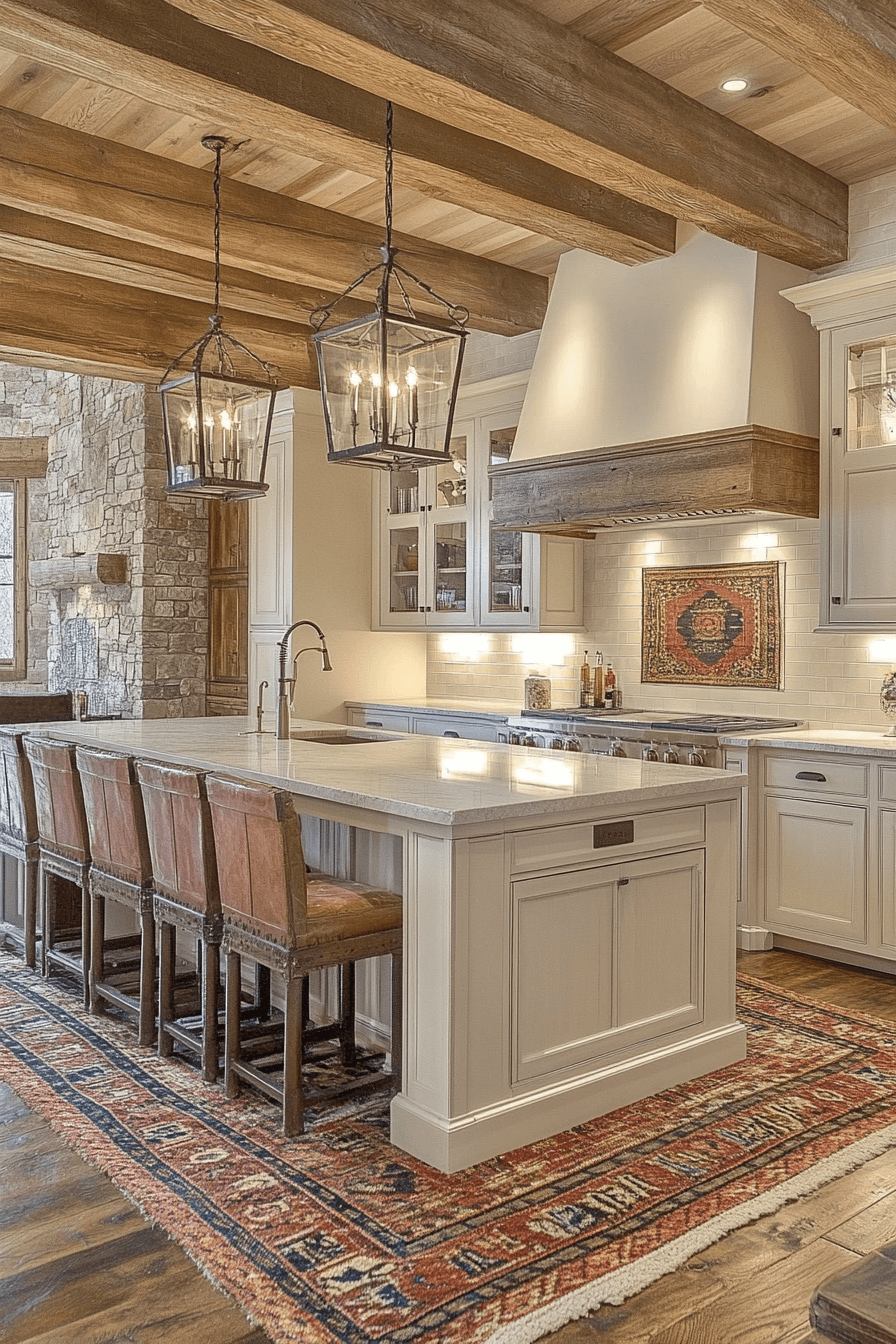
17. Use a textured or limewashed plaster finish on your range hood.
Forget the stainless steel range hood. Cover it in a limewashed plaster or Venetian plaster finish that matches your beige palette. The subtle texture variations catch light differently throughout the day, making your hood look like a piece of art.
18. Lay a natural fiber runner on the floor.
Jute, sisal, wool. A textured runner in front of the sink or along the island breaks up hard surfaces and adds a layer of warmth underfoot. It also signals that this isn’t just a kitchen — it’s a room you actually enjoy being in.
H2: The Hardware and Fixtures That Pull It All Together
Small details. Massive impact. Don’t overlook these.
19. Choose unlacquered brass or champagne gold hardware.
Chrome is cold. Matte black can feel too harsh against beige. But unlacquered brass develops a beautiful patina over time, and champagne gold adds a refined warmth without veering into gaudy territory.
20. Match your faucet finish to your cabinet hardware.
Mismatched metals can work — but only if you know what you’re doing. If you’re not sure, keep it consistent. Same finish on hardware, faucet, and any visible fixtures. Cohesion is king.
21. Swap out standard outlet covers for ones that match your walls.
This takes ninety seconds and costs almost nothing. But it eliminates those little white plastic rectangles that interrupt your beautiful beige walls like speed bumps on a freshly paved road.
H2: Lighting Tricks That Make Beige Glow
Beige without proper lighting is like a sunset behind clouds. You know the beauty is there, but you can’t quite see it.
22. Use warm-toned bulbs — between 2700K and 3000K.
Cool daylight bulbs make beige look gray and lifeless. Warm bulbs make it glow like honey in sunlight. Check the Kelvin rating on every single bulb in your kitchen.
This one swap alone can transform how your beige kitchen feels at night.
23. Install under-cabinet lighting.
LED strips beneath upper cabinets wash your countertops and backsplash in a soft, ambient glow. It eliminates harsh shadows, highlights your countertop material, and makes the whole space feel luxurious.
24. Add a dimmer switch to your main kitchen light.
Full brightness for cooking. Dimmed for dinner parties. A dimmer gives you complete control over the mood. And in a beige kitchen, that control is everything — because beige transforms dramatically based on light intensity.
H2: The Finishing Touches That Separate Good From Unforgettable
You’ve done the hard work. Now add the details that make people feel something when they walk in.
25. Display ceramics and pottery in beige and cream tones on open shelves.
Handmade ceramics in earthy tones add soul. They look collected, not decorated. Line up three or four pieces in varying heights and shapes, and your open shelves become a gallery wall.
26. Add greenery — but keep it simple.
One large potted plant or a few herb pots near the window. The contrast of green against beige is one of nature’s most beautiful combinations. It adds life without competing with your palette.
Olive branches in a stoneware vase? That’s the move.
27. Choose a beige or warm-toned stone composite sink.
A white porcelain sink stands out too much. A stainless steel one clashes with the warmth. A composite sink in a warm sand or biscuit tone disappears into your countertop and maintains the seamless flow.
28. Use consistent styling — group items in odd numbers.
Three canisters. Five cookbooks leaning against the backsplash. One cutting board. Odd numbers are more visually pleasing to the brain. Interior designers know this. Now you do too.
29. Pin your favorite beige kitchen images and study what they have in common.
Seriously. Go to Pinterest. Save the kitchens that stop your scroll. Then analyze them. You’ll notice patterns — the same undertones, the same balance of texture and simplicity, the same restraint.
That analysis is more valuable than any shopping spree.
H2: Now Go Build the Kitchen That Makes You Stay
Here’s the thing most design blogs won’t tell you.
A beautiful kitchen isn’t about the most expensive materials. It’s about understanding what makes a space feel right. It’s about undertones, texture, light, and intention.
Beige gives you the most forgiving, most versatile, most emotionally warm canvas to work with. But only if you respect its subtlety.
Don’t rush it. Don’t throw money at it without a plan. And for the love of everything good, don’t pick your paint color under fluorescent lighting at the hardware store.
Take this list. Work through it point by point. And build a kitchen that doesn’t just look beautiful in photos — but feels like home the moment you step inside.
Because that’s the real goal, isn’t it?
Not a kitchen that impresses strangers on the internet.
A kitchen that makes you want to stay.