Luxury Console Table Ideas That Feel Straight Out of a Designer Showroom
Disclosure : This post may contain affiliate links or paid partnerships. I may earn compensation if you click a link or make a purchase, at no additional cost to you. See my disclosure for more info.
You’ve been staring at that empty wall in your entryway for weeks now.
Maybe months.
Every time you walk through the front door, you feel it. That nagging little voice whispering: “This space could be so much more.”
You’ve scrolled through Pinterest until your thumb went numb. You’ve saved dozens of photos from Architectural Digest. You’ve walked into high-end furniture showrooms, touched the marble, admired the curves — and then quietly checked the price tag.
And walked right back out.
Here’s what nobody tells you about luxury console tables: you don’t need a designer’s budget to get a designer’s result. You just need to know what actually makes a console table look expensive. What separates the forgettable from the unforgettable.
And that’s exactly what you’re about to discover.
Whether you’re decorating a grand foyer or a narrow hallway, these ideas will help you create a space that stops people in their tracks. The kind of space where guests pause, look around, and say: “Who designed this?”
Ready? Let’s dive in.
Why the Console Table Is the Most Underrated Piece in Your Home
Think about it.
The console table is the first thing people see when they enter your home. Before the living room. Before the kitchen island. Before any carefully curated bookshelf.
It sets the tone. It tells your story. It whispers — or shouts — your taste to every single person who crosses your threshold.
And yet, most people treat it as an afterthought. A random table shoved against a wall with a bowl of keys on top.
That’s like wearing a stunning outfit and forgetting your shoes.
The console table is your home’s first impression. And you never get a second chance at a first impression. Not in life. Not in design.
So let’s make it count.
1. The Sculptural Stone Console That Commands Attention
You know those tables you see in designer showrooms that look more like art installations than furniture?
They’re almost always made of stone.
Travertine, marble, cast concrete — these materials carry a visual weight that no other surface can replicate. A sculptural stone console doesn’t need accessories. It doesn’t need a mirror above it. It doesn’t need anything.
It just is.
The trick? Look for organic shapes. Rounded edges. Arched bases. Asymmetrical silhouettes. These are the forms that interior designers obsess over right now.
A waterfall-edge marble console in a creamy Calacatta finish will make your entryway look like a gallery. Place a single ceramic vase on top, and you’re done.
Less is more. Especially when the piece itself is already a statement.
2. The Slim Metal-and-Glass Console for Tight Spaces
Not everyone has a sprawling foyer. Some of you are working with a hallway so narrow you can barely squeeze past the dog.
Does that mean you can’t have a showroom-worthy console? Absolutely not.
A slim brass-and-glass console solves the space problem without sacrificing style. The transparency of glass creates an illusion of openness. And the warmth of brass or gold-toned metal adds richness without bulk.
The key dimension to remember: look for consoles that are 10 to 12 inches deep. That’s narrow enough for a tight hallway, but wide enough to hold a lamp and a small tray.
This is the kind of piece that proves luxury isn’t about size. It’s about intention.
3. The Fluted Wood Console That Brings Warmth and Texture
Flat surfaces are boring. There. Someone had to say it.
Fluted detailing — those elegant vertical ridges carved into wood — transforms a simple console from ordinary to architectural. It’s a technique borrowed from classical columns, and it works spectacularly on modern furniture.
Think of a fluted oak console in a warm honey tone. Or a mango wood piece with deep, dramatic grooves. The play of light and shadow across those ridges gives the table depth and movement.
This is especially powerful if your space already has a lot of smooth, flat surfaces. Fluting introduces tactile contrast. It makes people want to reach out and touch it.
And when furniture makes people want to interact with it? That’s designer-level impact.
4. The Arched Console That Frames Your Space Like Architecture
Arches are everywhere in high-end design right now. Arched mirrors. Arched doorways. Arched bookshelves.
But an arched console table? That’s the move most people don’t see coming.
A console with an arched base — whether it’s a single sweeping curve or a series of smaller arches — introduces a sense of softness and sophistication that straight lines simply can’t achieve.
Pair it with a rectangular mirror above, and the contrast between the curved base and the sharp frame creates visual tension. The good kind.
This is designer thinking: it’s not just about finding a pretty piece. It’s about creating a dialogue between shapes in your space.
If you want your entryway to feel like it was composed rather than just decorated, an arched console is your secret weapon.
5. The Floating Wall-Mounted Console for a Clean, Modern Edge
Here’s something that instantly separates amateur decorating from professional design: negative space.
A wall-mounted console that appears to float creates a gap between the furniture and the floor. That gap is everything. It makes the space feel lighter. More open. More intentional.
It also makes cleaning underneath a breeze. But that’s a practical bonus, not the point.
The point is this: when your console doesn’t touch the ground, your entire entryway feels more curated and deliberate. Like someone really thought about it.
Choose one in a rich walnut or matte black finish. Keep the top minimal — a single candle, one book, maybe a small sculpture.
The emptiness around it is what makes it powerful. Don’t fill every inch. Let the space breathe.
6. The Bold Black Console That Anchors Everything Around It
You want a shortcut to making any space look expensive?
Go dark.
A black console table — whether it’s matte black metal, blackened oak, or lacquered ebony — acts as a visual anchor. It grounds the entire room. It gives every lighter element around it something to lean against.
Think about it this way: in fashion, a black dress works with everything. In design, a black console does the same thing.
But here’s where most people go wrong: they pair a black console with dark accessories. Don’t.
Contrast is king. Place a white marble tray on top. Add a brass lamp. Set a pale ceramic vase beside it. Let the darkness of the table amplify the beauty of everything around it.
That’s not decorating. That’s composing.
7. The Mirrored or Metallic Console That Plays With Light
Some rooms just feel dim. Low ceilings, limited natural light, walls that swallow brightness.
A mirrored or metallic console fights back against all of that.
Antiqued mirrored surfaces bounce light around the room without looking like a funhouse. Polished chrome or stainless steel adds a contemporary edge. Hammered metal creates warmth and texture even while it reflects.
The beauty of a light-reflecting console is that it works double duty: it’s a functional piece of furniture and a lighting strategy all in one.
If your entryway doesn’t have a window nearby, this is the idea that will change everything. Pair it with a table lamp and watch the light multiply across those surfaces.
Suddenly, that dark corner isn’t dark anymore.
8. The Console With Built-In Storage That Hides the Chaos
Let’s be honest for a second.
Your entryway is a battlefield. Keys, sunglasses, mail, dog leashes, that random charger you keep meaning to put away. It piles up. Every single day.
A console table with drawers or hidden shelving gives you a place to stash all of it. Out of sight. Out of mind. Out of the way.
But — and this is crucial — the outside still has to look stunning.
Look for consoles with push-to-open drawers (no visible handles) or ones with woven basket storage underneath. The goal is stealth luxury: beautiful on the outside, ruthlessly organized on the inside.
Because a space that looks calm but functions brilliantly? That’s the ultimate designer flex.
9. The Layered Styling That Turns Any Console Into a Showpiece
Here’s a truth that might sting a little.
You could own the most gorgeous console table ever made — and still have it look underwhelming. Because styling is half the battle.
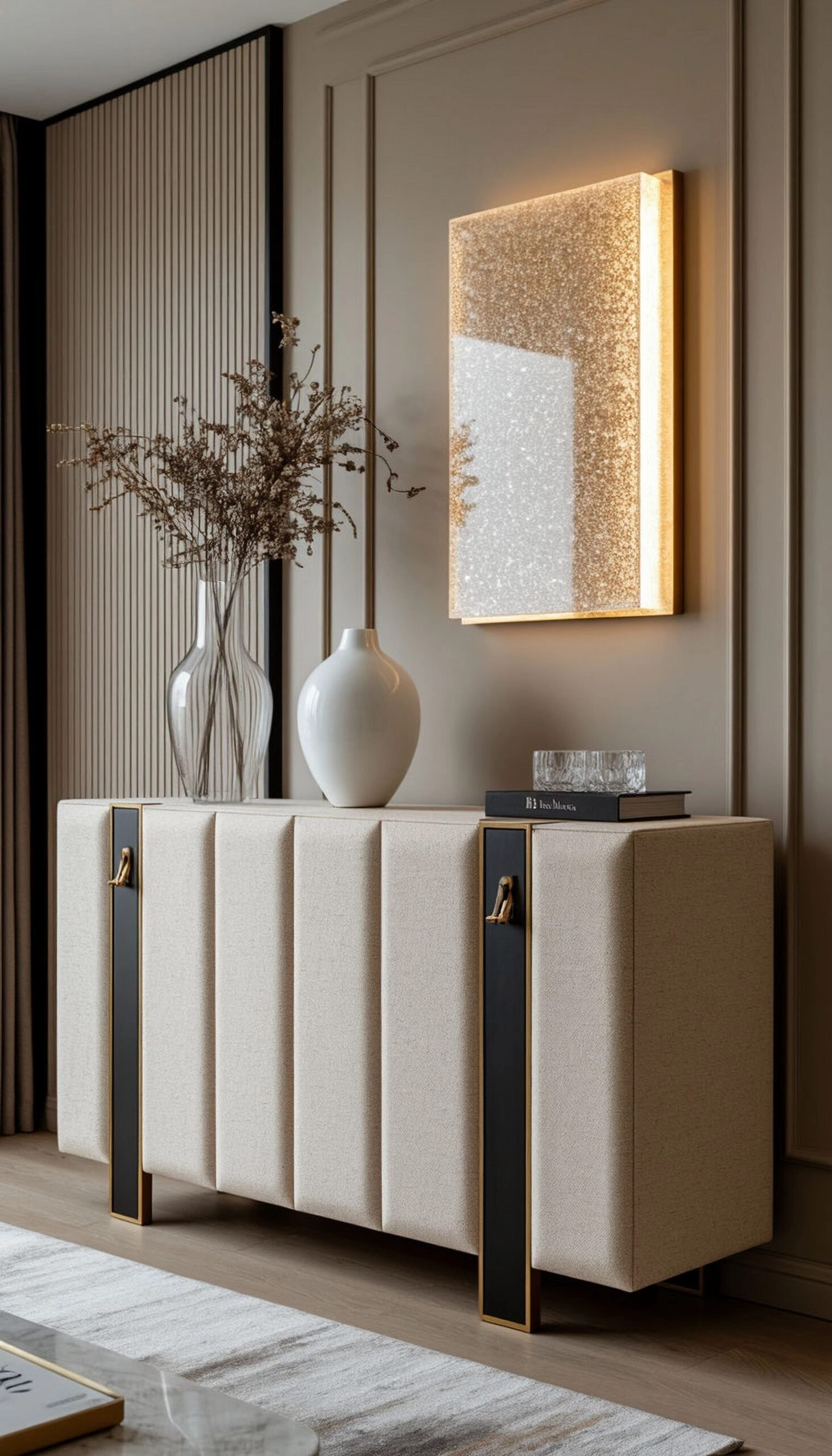
The formula that designers use is surprisingly simple. It’s called the rule of threes and varying heights:
- One tall element (a lamp, a vase with branches, a piece of art leaning against the wall)
- One medium element (a stack of books, a candle, a small sculpture)
- One low element (a tray, a small bowl, a decorative object)
Arrange them in an asymmetrical triangle. Step back. Adjust until it feels balanced but not rigid.
And here’s the part that changes everything: leave empty space between the groupings. Crowding every inch of the surface screams “I bought too much.” Breathing room screams “I know what I’m doing.”
10. The Unexpected Material Console That Nobody Else Has
Want to really stand out?
Skip the obvious choices. Skip the standard marble. Skip the predictable wood.
Go for something that makes people do a double take.
Rattan and cane consoles bring resort-level warmth into any space. Shagreen-wrapped surfaces (or faux shagreen — no judgment) add exotic texture. Resin consoles in bold colors — deep emerald, sapphire blue — become the centerpiece of the room.
A console made from reclaimed wood paired with raw steel legs tells a story of contrast and craftsmanship. A poured concrete slab on blackened iron legs looks like something straight out of a SoHo loft.
The point isn’t to be weird for the sake of being weird. The point is to choose a material that reflects your personality rather than following the crowd.
Because designer showrooms don’t play it safe. And neither should you.
The Mistake That Ruins Even the Best Console Setup
Before you go shopping, let me save you from the single most common mistake.
Choosing the wrong height.
A console table that’s too short looks like a bench someone forgot to sit on. Too tall, and it feels awkward, like a bar counter in a residential hallway.
The sweet spot? Between 28 and 34 inches tall. For most entryways, aim for roughly the same height as the back of your sofa — around 30 inches.
And here’s another one: ignoring proportion with wall art. If you hang a mirror or artwork above your console, the bottom edge should sit about 3 to 6 inches above the table surface. Not a foot above. Not touching.
These details seem small. But they’re the difference between “nice table” and “this looks like it was professionally designed.”
Your Entryway Deserves Better Than “Good Enough”
You know what your space needs now.
You know that the right console table isn’t just furniture — it’s the opening line of your home’s story. It sets the mood. It reveals your taste. It tells guests, before a single word is spoken, exactly who lives here.
You have two options.
Option one: keep walking past that empty wall every day, telling yourself you’ll deal with it eventually.
Option two: pick one idea from this list. Just one. And start building the entryway you’ve been imagining every time you scrolled through those designer photos at midnight.
The showroom look isn’t reserved for people with unlimited budgets or personal interior designers.
It’s for people who care enough to get the details right.
That’s you. And you know it.
Now go make that entryway unforgettable.
“The right console table is not just furniture — it is the opening line of your home’s story.”